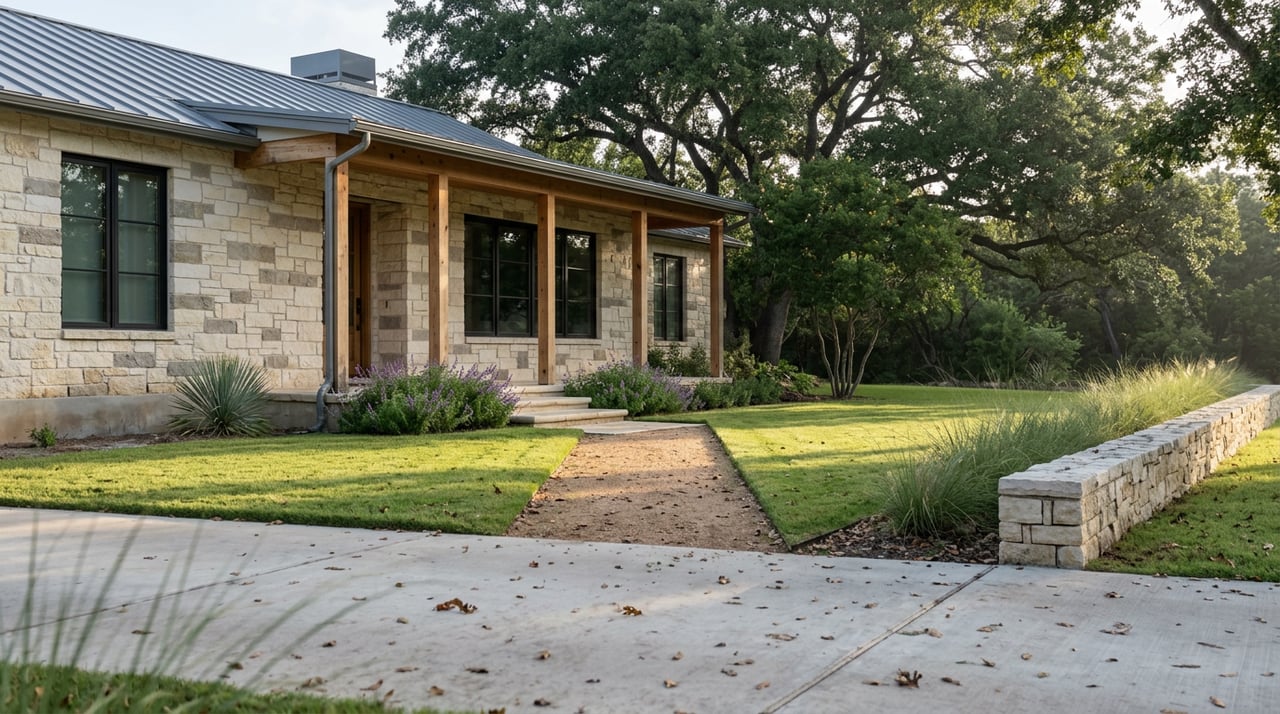
Why a Fredericksburg Home Can Sit Next to an Airbnb and Still Never Become One
September 17, 2026
September 17, 2026
An investor walks a three-bedroom cottage a block off a residential street in Fredericksburg, sees a cheerful lockbox on the porch two doors down, and assumes the zoning question is settled. If the neighbor runs a short-term rental, surely this house can too. That assumption is the single most common mistake buyers make before writing an offer here, and it has nothing to do with paperwork speed or bad luck. It has to do with a rule most people never think to ask about until it disqualifies them.
Fredericksburg's short-term rental ordinance, governed under Section 20.222 of the Zoning Ordinance and Chapter 23, Article V of the Code of Ordinances, does not treat proximity to an existing rental as proof that a new one is welcome. It treats it as one data point in a math problem. Get the math wrong and you can close on a house that will never legally operate as a whole-home rental, no matter how many Airbnbs sit on the same block.
The city sorts short-term rentals into a few categories. Accessory rentals, where the owner lives on site and rents a room or a detached structure, and bed-and-breakfast operations are allowed in residential zones without much friction. The category that trips people up is what the city calls "Unoccupied," meaning the owner is not living there and the whole house is the rental. In R1 and R2 residential districts, new Unoccupied STRs are not allowed by right.
There is an exception, and it is the part almost nobody checks before making an offer. A residential property can qualify for a special exception from the Zoning Board of Adjustments if it meets what the city defines as "stranded property" criteria. That means the lot has to share two property lines with parcels that either already hold an STR-Unoccupied permit or carry C2, CBD, or Public Facility zoning, and at least half of the properties within a 200-foot radius must also hold an STR-Unoccupied permit or sit on compatible zoning. In late 2023, the city council also added a factor for the Zoning Board to weigh whether any schools operate within that same 200-foot radius when a stranded-property exception comes up for a vote, a detail confirmed in the council's own meeting recap covered by JAM Broadcasting.
Stranded property test | What it requires |
|---|---|
Shared property lines | Two lines shared with STR-Unoccupied permitted land, or C2, CBD, or Public Facility zoning |
200-foot radius | At least 50 percent of properties in the radius must hold an STR-Unoccupied permit or compatible zoning |
Additional ZBA factor | Whether a school operates within that same 200-foot radius |
One rental two doors down does not clear this bar. The 50 percent threshold means a buyer needs a meaningful cluster of already-permitted or compatibly zoned neighbors, not a single anecdote.
This is the step that separates a confident offer from a costly guess. Before assuming a residential property can carry a whole-home rental, a buyer needs to pull the zoning map for the parcel and everything within 200 feet, then check that map against the city's Short-Term Rental Map, which the City of Fredericksburg maintains as a searchable database of every permitted STR address in town. That map exists precisely because the city cross-references licensed addresses against active listings, so it doubles as the fastest way to see how many of a target property's neighbors already qualify.
Skipping this step does not just risk a denied special exception. It risks writing an offer on a property an investor believes will cash flow as a rental, only to learn during due diligence that the neighborhood simply does not have the density of existing permits needed to clear the ZBA. At that point the only paths forward are an accessory or bed-and-breakfast structure with an owner living on site, or a property in the extra-territorial jurisdiction, where no city permit is required at all but state and county hotel occupancy tax still applies.
A rental next door proves the neighborhood tolerates short-term rentals. It does not prove the city will let you run one.
Even when a property clears the zoning test, buyers often assume that if the current owner has a valid STR permit, it transfers with the sale the way a survey or a title policy does. It does not work that way in Fredericksburg. The city's own Short-Term Rental Permit FAQ states plainly that an inspection is required before issuing a new permit, when a permit is transferred to another owner, whenever a complaint comes in, whenever the structure is modified, and at every annual renewal. A change of ownership triggers the same inspection a brand-new applicant would face, not a rubber stamp.
That means a buyer closing on a currently compliant, currently rented property should budget time and attention for a fresh inspection before assuming income starts on day one. The permit itself costs $150 per unit plus $100 per bedroom and is valid for one year, so it is not an expensive line item, but it is a real one, and it comes with a hard ceiling on occupancy: the lesser of two guests per bedroom plus two, or one guest per 200 square feet of floor space, capped at 12 adult occupants regardless of bedroom count. Properties permitted before April 1, 2022 are grandfathered under the older occupancy standard of one occupant per 200 square feet, but even those non-conforming units still have to meet current rules on life safety, the 24-hour local contact requirement, signage, and hotel occupancy tax remittance.
That tax is another line item worth knowing before an offer goes in. Every permitted rental owes a combined 13 percent hotel occupancy tax, split between the city's local rate and the state's share, filed quarterly whether or not the property earned a dollar that quarter. A zero-revenue quarter still requires a filed return.
None of this friction matters in isolation. It matters because of what the current market is doing to the payoff on the other side of it. According to AirDNA's 2026 overview of the Fredericksburg market, the city carries roughly 3,338 active short-term rental listings, with average annual revenue per listing around $36,200, occupancy near 40 percent, and an average daily rate close to $334. In the twelve months ending June 2026, revenue per listing declined 15.2 percent even as the number of active listings grew 6.9 percent, meaning more properties are splitting a smaller total pie.
That is the number that should reshape how hard an investor fights for a borderline R1 property. Clearing a stranded-property exception, waiting on a Zoning Board hearing, and passing a change-of-ownership inspection are all worth the effort when the payoff is a durable, well-located rental. They are a much tougher case to make on a marginal lot when the same 2026 data shows softer occupancy and a shrinking per-listing revenue pool. The properties still capturing the spring and fall demand spikes are the ones that are both compliant and competitively positioned, not the ones squeezing through a zoning exception on a technicality.
Does an existing STR permit transfer automatically when I buy the house? No. The city requires a new inspection at the point of ownership transfer, the same as it would for a first-time applicant.
What if my target property sits in the extra-territorial jurisdiction instead of inside city limits? ETJ properties do not need a city STR permit at all, though they still owe state and county hotel occupancy tax. That makes the ETJ a genuinely different calculation than an in-town R1 lot facing the stranded-property test.
Where do I check zoning and permit density before I make an offer? Start with the city's zoning map and cross-reference it against the Short-Term Rental Map on the city's official STR page. Counting existing permits and compatible zoning within 200 feet of a specific parcel is the only way to know in advance whether a stranded-property exception is even worth pursuing.
Buying with short-term rental income in mind takes more than a good instinct about a neighborhood. It takes someone who will count the radius, check the transfer rules, and run the current revenue math before you fall in love with a listing that might never clear the board. That is the kind of due diligence Kelly Jo Gonzalez builds into every Hill Country transaction. Start Your Hill Country Journey and let's find out what a property can actually become before you write the offer.
Stay up to date on the latest real estate trends.
Real Estate
As your real estate agent, Kelly Jo Gonzalez is committed to making the home buying and selling process as smooth as possible. She will listen to your needs and criteria in finding you your “Dream House” and will be dedicated to keeping you informed throughout each step.
Kelly Jo Gonzalez
321 Hale Street, Fredericksburg, TX 78624 1002 River Road, Suite 300 Boerne, TX 78006